Technologies and Skills

LEADSx2030 has developed an AI-powered data model to analyse and forecast the demand for advanced digital skills in Europe, based on online jobs postings.


It processed a total of 3M job advertisements, identified 200 thousand that met basic criteria, including reference to advanced digital skills, from which it analysed a wide sample of 10 thousand.

Total job posting processed
0
Met criteria
~ 0
Sampled
~ 0

Categorised by technology area Skill pockets defined

Estimated ICT vacancies EU27, 2025
0

ADS demand by tech area 2025

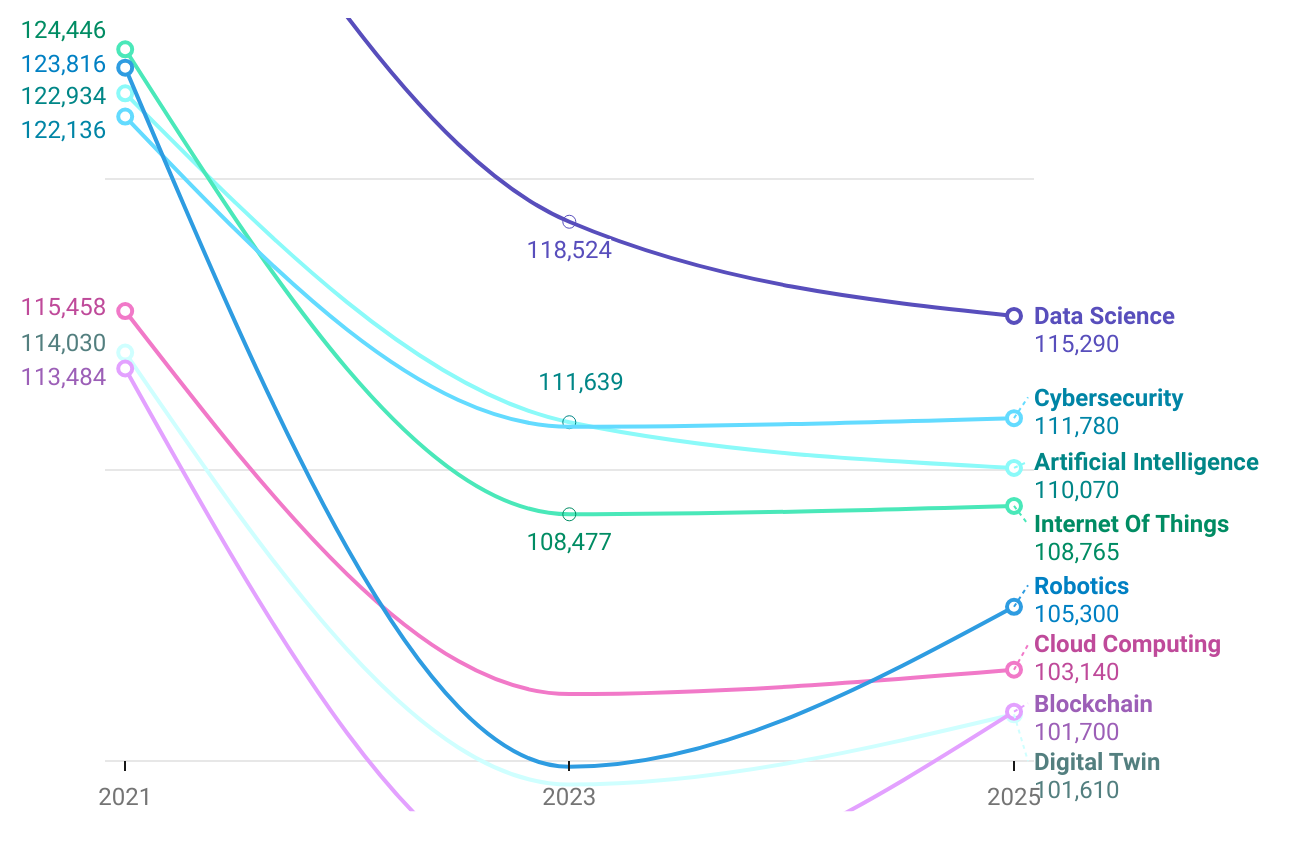
Data science, cybersecurity and AI top the chart for 2025, with more than 110 thousand job postings requiring relevant skills.

ADS demand by tech area 2025

Some notable changes from 2021 are the drop of Robotics, IoT and Cloud Computing, as well as the rise of Cybersecurity over AI.


These changes do not necessarily reflect the (de) growth of the respective tech areas, but can be rather influenced by preceding hiring booms, e.g. during the Covid pandemic.

In the LEADSx2030 data model, ADS are intelligently aggregated into skills pockets, which group together similar or complementary skills.

Top skills pockets 2025

Skill PocketRank 20252025
Information Security1 (2)58977
Data Protection2 (0)56656
Data Analytics3 (-2)54864
Information Systems4 (7)52397
Data Engineering5 (0)46294
Business Analytics6 (11)43637
Data Management7 (-3)38428
Programming8 (-2)34549
Systems Engineering9 (17)33394
Software Development10 (4)32650
Cloud Services11 (2)32282
Experience Design12 (9)32215
DevOps13 (-5)31416
Business Technologies14 (-5)31199
Machine Learning15 (12)31102

Cloud security

22nd (+18)

Biggest riser

2023 – 2025

33rd (-21)

Biggest loser 

2023 – 2025

Quality security

Information Systems Index

Information systems is a broad skills pocket which applies across several tech areas.

Its major presence perhaps indicates that generic IT skills are being referenced in job ads, while industries seek to define new emerging skillsets.

Overall, there is a notable trend for the increase in security solutions, data management and governance skills, with a corresponding drop for the more infrastructure and less engineering-based skills pockets. Such examples including testing, UX, knowledge and applications.